MODO REVIEW
  • Reviews
  • Contact

My Own Damn Opinion

Reviews of theatre productions I encounter in my travels... and pretty much anything else that strikes my fancy.

Contact Me

Big Love

10/31/2013

0 Comments

 
Picture
Love cannot be wrong.

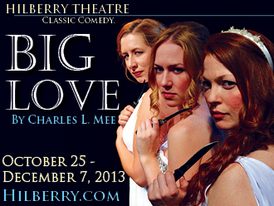
It's a pretty wild ride when a play that involves a number of harsh invectives against opposing sexes, followed up by a good, old-fashioned group slaughter, ends with this particular lesson.  And in The Hilberry's production of Big Love, that wild ride is definitely worth the ups and downs, the backs and forths, the blood and guts that it takes to get there!

Based on Aeschylus's The Suppliant Women (the oldest extant piece of Western dramatic literature), Big Love is the story of fifty sisters (represented in the play by only three: Lydia [Sarah Hawkins Moan], Thyona [Danielle Cochrane] and Olympia [Megan Barbour]) who have just run away from their pre-arranged wedding to their fifty cousins (represented in the play by only three: Nikos [Brent Griffith], Constantine [David Sterritt] and Oed [Brandon Grantz]).  Having made their Greek escape, they come upon an Italian estate and a young man named Giuliano [Topher Payne].  The estate, Giuliano informs them, is owned by his uncle Piero [Brandy Joe Plambeck] and Piero's mother Bella [Annie Keris] - and it is to Piero that the women turn in hopes of asylum from their forced marriages.  Of course, the men follow, the women are indeed forced to marry, and they make a pact that none of the grooms will live through their wedding night.  Ripe subject matter for comedy... right?

Well, it turns out that this millenia-old tragedy is, in fact, fertile ground for laughter in the hands of playwright Charles L. Mee and director Blair Anderson.  The contemporary adaptation, which premiered in 2000, puts gender roles on display in all their raw, naked, messy glory - and we can't help but laugh at the absurdity.  But the laughter bangs up against the painful truth - as Constantine tells us - and we never really can escape the pain if we are to truly live.  Anderson's staging is almost ritualistic, evoking the Greek roots of the play.  And though I think he shied away from some of the iconic script elements (alas, I waited all night for a "seductive hostile butt dance" that never came*), and the slaughter lacked the desperate violence that I think it needed, in general, he and movement director Cheryl Turski sculpted emotionally thrilling and thematically illustrative stage pictures and movement pieces that made for a vivid and lively performance.  And as for the language - which is poetic and winding and even downright mystifying at times - Anderson and his cast weave in and out of the words with fluidity and wit.  The fact is: this is a production in which everyone - director, designers and actors - seem to be really, truly enjoying themselves.

The central six characters are uniformly strong.  Sarah Hawkins Moan is powerful and relatable as the conflicted Lydia.  Danielle Cochrane is simultaneously formidable and fragile as the militant Thyona.  Megan Barbour is a hoot as the materialistic, pin-up girl Olympia.  (Truth be told, Barbour steals more than a few scenes with her spot-on comic delivery and her calculated ditziness.)  David Sterritt is unsettling and charismatic as the angry and entitled leader of the men, Constantine.  He is somehow able to remain likeable to the audience while spewing some of the darkest lines of the play.  Brandon Grantz is charming and agile as the retiring Oed.  And Brent Griffith as Nikos does a wonderful job humanizing "the enemy," bringing heart and complexity to the men's side of this particular battle.  Rounding out the laudable ensemble, the peripheral characters are delightful as well.  Topher Payne's Giuliano is wistful and endearing as he battles alongside the women for his own self-actualization.  Brandy Joe Plambeck is grounded and cool as the pragmatic Piero, and delightfully alive as Leo (and oh, that shirt!).  And while Annie Keris is amusing as the daffy weekender Eleanor, her turn as Bella is simply superb.  With razor-sharp comic timing and lyrical sincerity, she deftly navigates Mee's poetry and, when all is said and done, does no less than anchor the show (and oh, the tomatoes!). 

The scenic design by Leazah Behrens is effective, giving us a sort of sacred circle that becomes both the classical Greek altar on which the action unfolds, as well as the boxing ring where the grand bout plays out.  The projections, created by Sarah Pearline, are sometimes useful, sometimes less so, but pretty much always attractive and interesting.  Thomas Schraeder's lighting design does its part to play up the battle of the sexes with dueling beams of pink and blue light fighting it out on the predominantly white costumes.  And speaking of which: the costumes by Anne Suchyta are generally a lot of fun.  The wedding gowns are lovely, and the individual pieces worn by the brides-to-be do a great job painting their unique characters (though I have to admit, Olympia's costume really didn't seem to fit the actress very well).  And the few men who aren't decked out in their wedding tuxes bring just the right interest and flair to the stage (Leo's shiny orange shirt, for example, is burned into my brain!).  The sound design by Samuel Byers and original music composed by Bobby DeLisle are evocative and entertaining, supporting the action and movement of the play with cleverness and insight.

Despite what the Hilberry may tell you, Big Love is not exactly a "classic" in the classic sense - and the season is all the better for its inclusion.  Big Love is a postmodern explosion of poetry and imagery and sensation and love.  It's a story worth seeing, ideas worth hearing, emotions worth feeling... and man, is it just a helluva lot of fun!

Big Love by Charles L. Mee (Director: Blair Anderson; Lydia: Sarah Hawkins Moan; Olympia: Megan Barbour; Thyona: Danielle Cochrane; Bella/Eleanor: Annie Keris; Piero/Leo: Brandy Joe Plambeck; Giuliano: Topher Payne; Constantine: David Sterritt; Oed: Brandon Grantz; and Nikos: Brent Griffith) continues at The Hilberry Theatre through December 7.  Tickets range from $12-$30.  For more information, visit http://theatre.wayne.edu/ourshows.php or http://hilberry.wordpress.com/.

*In the script there is a stage direction that calls for a "seductive hostile butt dance."  This is up there with "Exit, pursued by bear" as one of the greatest stage directions of all time.

0 Comments

Fiddler on the Roof

10/21/2013

0 Comments

 
Picture
On Saturday, October 19 I attended Eastern Michigan University's production of that old musical theatre chestnut, Fiddler on the Roof in the Quirk Theatre.  Addressing issues of family, tolerance, and, of course, tradition, the lessons of this show are all too fitting for a contemporary audience, and the production itself is earnest and well-sung, and one that the students should be proud of.

Based on the stories of Sholem Aleichem, Fiddler on the Roof is the story of the small Russian town of Anatevka at the beginning of the 20th century, when anti-Jewish sentiment was creeping across the land with horrifying results.  The milkman Tevye, his wife Golde, and their five (yes, FIVE) daughters are the lens through which the changing times are focused.  As the outside world encroaches on this tiny town, they begin to find that their position is even more precarious than that of their title fiddler.

Director Pirooz Aghssa approaches the show with clear affection for the piece.  His staging is simple and usually effective, though the pace has a tendency to drag.  There were a few opportunities (both comic and dramatic) that were missed: Many jokes that draw explicitly on Jewishness felt like they whizzed by the cast.  The disruption at Tzeitel's wedding lacked the menace that we needed hanging over us as we headed out for intermission.  And the lamenting farewell to Anatevka felt a little unfocused.  But if there is one thing Aghssa does right, it's sentimentality.  Young love and fatherly love were the stars of the show, and he handily shaped moment after moment to build the characters' attachments to one another, making their hardships all the more painful for the audience to bear.  On the other hand, Jennifer Graham's choreography was a little stagnant throughout.  She seemed to be opting more for sculpture and tableau than movement to communicate the songs, and the energy and interest of the numbers often suffered for it.

Rick Eva anchors the production as a likeable, funny and emotionally complex Tevye.  Though his vocals are not always as strong as I might have liked, he more than makes up for it with Tevye's consistent charm and sincerity.  He has good comic timing, treats his onstage family with warmth, and earns some truly heartbreaking moments.

Michael Herman as Motel the Tailor was a clear stand-out.  In his hands, Motel is a quirky, twitchy, endearing little guy who we root for in his quest for the little bit of happiness he hopes to carve out for himself.  Kasey Donnelly as Tzeitel, Amber Lawson as Hodel and Kristin McSweeney as Chava are lovely as Tevye's three oldest daughters - the heart of the play.  I particularly enjoyed Lawson's clear-as-a-bell voice, and McSweeney's sweet, genuine portrayal of Chava was lovely and powerful.  Elliott Styles and Gage DeAngelis were strong as Perchik and Fyedka respectively, providing worthy, apt, and distinctly charming companions for Hodel and Chava. Helena Bardakjian was solid as Golde, Tevye's long-suffering wife. Nancy Walker's Yente - the fast-talking matchmaker (a role that has the opportunity to steal the show) - delivered a disappointing performance, plowing past punchlines and missing the overall spirit of the character.   Lauren Zamiska as the adorable Grandma Tzeitel and Sydney Woll as Fruma-Sarah did admirable work bringing Tevye's dream into its own strange little pocket of Anatevka.  And Jeffry Ogden as Sasha deserves special mention for the crystalline tenor he lends to a couple of numbers.  The chorus performs commendably throughout, with strong voices and focus that fill out the town well.

The evocative and beautifully spare set design by John Charles uses silhouette and sketchy lines as an elegant illustration of the precariousness of Anatevka and its occupants.  Brian Scruggs's lighting design supports the set splendidly, reinforcing the mood from scene to scene with painterly appeal.  Melanie Schuessler's handsome costumes top off the strong design package of this production with historical accuracy and the characteristic simplicity that defines the world of this Fiddler.

EMU's stop at Anatevka is all too brief, with only two weekends in their run.  So if you're in the mood for a solid evening of classic musical theatre, you don't have much time before the sun sets on this one.

Fiddler on the Roof by Joseph Stein, Jerry Bock and Sheldon Harnick (Director: Pirooz Aghssa) continues at Eastern Michigan University's Quirk Theatre through October 27.  For more information, visit http://www.emich.edu/cmta/productions/2013season/fiddler.php

0 Comments

Our Town

10/20/2013

0 Comments

 
Picture
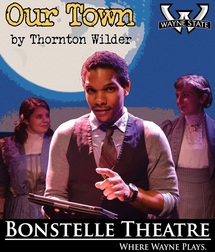
Our Town by Thornton Wilder is a tough, tough play to stage.  First, it is one of the best-known and most often produced American plays in history.  Second, unlike most plays - which are written about days that are special because they are unlike any other day - Our Town is written about days that are just like any other day, making the poetic and haunting argument that our daily life deserves notice, scrutiny and appreciation every bit as much as any more strictly dramatic day.  Third, Wilder's script calls for the use of pantomime rather than the literal props to which theatergoers are more accustomed - therefore demanding much more in the way of imagination from performers and audience alike.  These challenges were taken on by the undergraduate students at Wayne State University's Bonstelle Theatre this weekend - and unfortunately, they were not always successful.

Our Town is the story of the people of Grover's Corners, NH - in particular the neighboring Gibbs and Webb families whose children (George and Emily respectively) experience love, marriage, parenthood and death - all in about two hours (or 14 years, depending on your perspective).  Narrated by an omniscient fellow referred to only as The Stage Manager, a whole cast of characters from the town fill in the world around George and Emily, painting images of an uneventful, but thoroughly American small town existence at the turn of the 20th century.

Director James Thomas gives us a presentational world in which the characters rarely manage to find the sincerity that the play begs for.  There is a cold detachment to the performance that, though it is clearly intentional, makes the action difficult to invest in.  And though the third act (yes - it's a three-act play, but it's still a brisk two hours, so don't be scared) is written as a huge departure from the world established in the first two acts, this production does little to communicate the change.  But perhaps the most frustrating elements are the swing set and the Stage Manager's iPad.  There is an old adage (attributed to Anton Chekhov) that if a gun appears on stage in the first act, it must be fired by the final act.  Basically this means that everything should be on stage for a reason.  But we have no such satisfaction here.  In a play intentionally lacking in scenery (The Stage Manager tells us that the play doesn't need any), the prominent swing set upstage center is all the more prominent for its being entirely unnoticed and unused by the actors.  And though I quite like the choice to make the Stage Manager a contemporary presence, he never actually uses the iPad slung conspicuously at his side.   

The performances are, as I mentioned before, usually a little detached and difficult to relate to, but I will say that they do feel like they are all inhabiting the same world together, which is no small feat.  22 people all agreeing on one set of given circumstances is always an accomplishment.  Zyle Cook and Kristin Dawn-Dumas as George Gibbs and Emily Webb have some genuinely charming moments - the soda shop sequence is definitely one of the strongest of the show, in my opinion - but they have a hard time finding the depth of loss that each character eventually goes through.  Katelyn Foster (Mrs. Webb), Luke Rose (Mr. Webb), Gaia Klotz (Mrs. Gibbs), and Carl Bentley (Dr. Gibbs) all do a fine job playing much older characters - and Rose's moment with his daughter before her wedding is very sweet.  And, as our emcee for the evening, Dante Jones plays the Stage Manager with energy and focus.  The auxiliary characters slide in and out of the action of the play without making much of an impression - though Breon Canady as Mrs. Soames and Anthony Scamihorn as Simon Stimson both have some memorable moments.

Perhaps the biggest problem with this production comes in the form of its design elements.  The set (designed by Lisa Charlotte Berg) - a mostly bare stage draped with white curtains - dwarfs the actors.  And the lovely though irrelevant swing set draws unearned attention time and again.  The little sculpture of clocks and knick-knacks that surrounds the Stage Manager's perch is interesting, but completely unrelated to anything else on the stage.  The lighting by Leah McCall is limited and often fails to provide even basic illumination, let alone communicate mood or provide visual interest.  I'm not sure whether the few projections were the purview of scenic or lighting, but they were clumsily executed, and the relentless merry-go-round footage playing during the first intermission threatens a bout of seasickness or vertigo if a hapless audience member allows his/her gaze to linger too long.  Michael Hallberg's sound design, though well-intentioned, is often fairly low-quality, and the high-pitched clinking of the milk bottles is particularly hard on the ears.  That said, Mary Gietzen's costumes stand out among the technical elements; they are simple and effective, they look good on the actors, and they serve the play and its characters very well.

I love watching undergraduates perform - I root for them with every step, and I forgive their productions a lot of foibles that I would not forgive a professional theatre.  And while Our Town at the Bonstelle Theatre was not, in my opinion, a particularly successful endeavor, I applaud the students for their hard work on what may well be the most difficult piece many of them have tackled at this point in their young careers.

Our Town by Thornton Wilder (Director: James Thomas) closed at Wayne State University's Bonstelle Theatre on October 20th.  For more information about upcoming shows, visit http://theatre.wayne.edu/ourshows.php

0 Comments

The Sisters Rosensweig

10/6/2013

0 Comments

 
Picture
"Grown-ups can be difficult." 

This may be the moral of the late Wendy Wasserstein's 1992 play The Sisters Rosensweig, now in production at the Jewish Ensemble Theatre.  The story of three grown sisters who come together for the eldest's birthday is witty and charming, but (as is often the case with Wasserstein) it's also a little long, and a little narrow in its appeal.  Still, the JET's production has some genuinely funny and heartfelt moments that, despite some of its inherent problems, make it a generally pleasant evening at the theatre.

The play takes place in 1991 on ex-pat and rock-star banker Sara Rosensweig-Goode's (played by Sandra Birch) 54th birthday.  Her sisters (Pheni the nomad played by Kristin Condon and Gorgeous the perfect suburban wife played by Emily Rose), daughter (the ever-idealistic and opinionated Tess played by Madison Deadman) and friends gather to celebrate, since her recent "female illness" had prevented her from attending her mother's funeral earlier in the year.  Pheni's bisexual boyfriend Geoffrey (Lindel Salow) invites his supplier of synthetic furs, Mervyn Kant (Phil Powers) to join them for dinner, and he turns out to be more than Sara bargained for.  As each woman is forced to face up to her own personal challenges, she finds strength in the other women Rosensweig... and of course, in herself.

Artistic Director David Magidson helmed this production with technical grace.  His blocking makes this sprawling space feel like a familiar home, and he does a good job of creating a relatable family vibe.  The show is long, and there are moments when the pace drags, but for the most part Magidson handled this fairly talky, idea-heavy play well.  Wasserstein's plays always come with the problem of being about a very tiny slice of privileged society, and can come off a little inaccessible, but Magidson found enough of the humanity in the play to avoid this trap for the most part.

The title sisters were a powerful trio, whose distinct personalities set themselves apart and yet managed to connect them as well.  As Sara Goode, Sandra Birch is a lovely presence.  She is tough and vulnerable in all the right places, and her inner turmoil is clear and human.  Kristin Condon's portrayal of Pheni is charming and strong, with a delicate balance of free spirit and homebody that produced one of my favorite performances of the evening.  And Emily Rose's Gorgeous Teitelbaum thundered about the stage like a brightly colored, stylish freight train - and I do mean that in the nicest way possible.  The sisters felt like different people, but the idea that they could have come from the same mother was also very clear.  As Sara's daughter Tess, Madison Deadman made the stage her own.  And her final moment with Sara - a lovely mother-daughter connection - put an excellent cap on the evening.  Lindel Salow as the flamboyant Geoffrey sometimes seemed to be pushing a little too hard, but he did have some really lovely, honest moments with Pheni that kept me in his court.  Phil Powers as Mervyn Kant met the hefty task of going toe to toe with Birch's Sara with a great deal of charm, making his Merv's tenacity and ease attractive and empathetic.  Eric Eilersen had promise as Tess's activist, lower-class London boyfriend, and but for his extremely muddy dialect, was ultimately as cute and out of place as he needed to be.  John Forman as right-wing tycoon Nicholas Pym was every bit the uptight Brit, but never quite managed to make his presence felt among the other strong personalities on stage.

It pains me to consider a piece from the 1990s to be a period piece, but in many ways (not only the specific references to the fall of the Soviet Union), this is a play that is very much of its time.  Scenic Designer Jennifer Maiseloff and Prop Designer Diane E. Ulseth worked together effectively to create this posh London home.  Neil Koivu's simple lighting design and Matthew Lira's sound design both worked well (though I wish the 'Cliffe Cleffs had sounded a little better).  And Mary Copenhagen's costumes put the cherry on the 1990s cupcake, planting us in time, and deepening the characters.  The costumes during the birthday party were particularly vibrant, fun, and communicative. 

If you have the time, and the patience for a bit of intellectual and idealistic meandering - with some genuine humanity and a little bit of romance tossed in for just enough sweetness - The Sisters Rosensweig is ultimately a fine way to spend an evening.  And there isn't even a pop quiz about the Concert of Europe at intermission...

The Sisters Rosensweig by Wendy Wasserstein (Director: David Magidson; Sara Goode: Sandra Birch; Tess Goode: Madison Deadman; Pheni Rosensweig: Kristin Condon; Geoffrey Duncan: Lindel Salow; Mervyn Kant: Phil Powers; Gorgeous Teitelbaum: Emily Rose; Tom Valiunus: Eric Eilersen; Nicholas Pym: John Forman) continues at the Jewish Ensemble Theatre through October 20th.  For more information, visit http://www.jettheatre.org/.

0 Comments

Agents of S.H.I.E.L.D.

10/3/2013

0 Comments

 
Picture
Okay... they're not all going to be plays, it turns out.  Mostly they will be, but I just can't help myself.

Airing on Tuesday nights, the much-anticipated Joss Whedon/Marvel comics joint venture has had two episodes now, and - as awesome as that duo sounds - I am sad to say that so far I am unimpressed.  Based loosely on the world created to great effect through the Iron Man franchise, Thor, Captain America, The Incredible Hulk (sort of) and The Avengers, on paper, this show should be every bit as cool as its cinematic counterparts.  But alas, so far they are falling way short.

The premise is that an unlikely but elite team of experts is assembled by Agent Coulson (Clark Gregg) of S.H.I.E.L.D., who everyone without Level 7 clearance thinks is dead (if this is the case, why is he so free about just wandering around during strange happenings where anyone with a cell phone could make his being alive a matter of public record rather than eyes only?).  The muscle on the team is Agent Grant Ward - a no-nonsense, get-the-job-done, I-work-alone type of guy who is just a little too pretty, and a little too soft for the gruffness that they seemed to want the character to have.  The two genius-yet-bumbling scientists - Fitz and Simmons - are played by Iain De Caestecker and Elizabeth Henstridge with a little too much cutesie blabbering, and not enough substance.  The gutsy wild card is Skye (Chloe Bennet) - a hacker who the team pulled out of an anti-government group called The Rising Tide.  After one encounter (in which she was the criminal), they have given her carte blanche on this super secret government team.  The team is rounded out by Melinda May (Ming-Na Wen), the requisite highly skilled, disillusioned badass who came out of retirement at Coulson's request.  At this point she's a little one dimensional, but also probably the only one of the team other than Coulson who seems old enough and good enough at her job to really be doing what she's doing.

The show is suffering from a few conflicting sets of expectations.  First, there is the legacy of the films from which it was born.  Obviously when you go from summer blockbuster to weekly TV show, there is going to be some culture shock.  Budgets are different, the story is not as compact and refined.  But I suspect that the bigger problem is coming from the studios.  Because of its box office predecessors, there is likely a desire to make this show reach a wide audience.  And wide audiences are great... except that if you make something that is supposed to be for everyone, it ends up not being interesting enough to hold anyone's attention.  And this is where the second set of conflicting expectations comes in: this is a Joss Whedon show, and Joss Whedon fans will tune in looking for what they've come to expect from Joss - witty Whedonverse dialogue, kickass chicks, distinctive characters, genuine suspense, deliberate giving and withholding of information in service of a long term plan... but so far what we have is milquetoast.  Based on the dialogue, Agent Ward should be older and colder (think Adam Baldwin from Firefly), but that wouldn't be as appealing to tweens, so we have a pretty boy instead.  Skye is smart, but has none of the badassery of the rest of the Whedon chicks.  Even she is questioning her usefulness on the team, as so far her most tangible contribution has been an inspirational cliche and SPOILER ALERT - Episode 2 - her ability to defy physics with only the help of an airplane safety card and a rubber raft.  Fitz and Simmons are clearly Topher from Dollhouse and Kayley from Firefly reincarnated in (so far) less endearing form.  Clark Gregg is delightful, because I'm not sure that he knows how not to be, but a show can't survive on a few sideways references to The Avengers, some cameos, and the fact that Clark Gregg might be one of the most lovable dudes in America. 

Right now it's novel - and because we liked the movies so much, and because it's Joss Whedon (it's really fun to see some of the faces from shows past pop up), a lot of people are probably giving Agents of S.H.I.E.L.D. a try.  But when it comes down to it, this is a Marvel movie that isn't a movie, and a Joss Whedon show that isn't a Joss Whedon show, so the foundations of the things people love about the basic building blocks of the show are not part of it.  If they don't find a way to get us invested in these characters, to raise the stakes (SPOILER ALERT - Episode 2 - How is it possible that a gaping hole in the side of an airplane coupled with active fighting with Peruvian militia could be this entirely unexciting?  And I'm sorry... a raft?  Really?), to create a real sense of mystery (SPOILER ALERT - Episodes 1 & 2 - a text message and a vague comment about what Coulson can "never know" are just not cutting it so far on the long-term suspense front)... Level 7 isn't going to be around for long.  Previous Whedon shows all took time getting their sea legs - the first season of Buffy the Vampire Slayer is sometimes pretty hard to watch, and Dollhouse and Firefly took too long to get going, so that by the time they were really interesting, they were already cancelled.  Here's hoping Agents of S.H.I.E.L.D. finds its footing... fast.

Agents of S.H.I.E.L.D. airs Tuesday nights on ABC...and whenever the hell you want on Hulu.

0 Comments

    Author

    As a maker, scholar, and watcher of theatre, these are just my own damn opinions.  And if they happen to be useful to you, then that's super.

    Archives

    August 2014
    July 2014
    June 2014
    May 2014
    April 2014
    March 2014
    January 2014
    December 2013
    November 2013
    October 2013
    September 2013
    April 2013
    March 2013
    October 2012
    July 2012

    Categories

    All
    Comedy
    Movies
    Musical
    Parody
    Review
    Shakespeare
    Television
    Theatre

    RSS Feed

Powered by Create your own unique website with customizable templates.